
New Feature: Call Quality Metrics Put Voice Performance in View
A phone system should make communication easier, not leave employees wondering why a call sounded delayed, choppy, or unclear. With the new Call Quality Metrics feature, users can now see quality data related to their calls and identify potential problems before they become a larger business issue.
The feature uses MOS scores to provide a simple, practical view of call quality. Rather than relying only on caller complaints or guesswork, teams can monitor trends and spot calls that may need further investigation.
What Are Call Quality Metrics?
Call quality metrics are measurements that help show how well a voice call performed over the network. They can help identify conditions that affect how a call sounds, such as audio delays, dropped words, choppy speech, or one-way audio.
For most users, the key measurement is the MOS score.
MOS stands for Mean Opinion Score. It is a widely used voice-quality rating on a scale of 1 to 5, where higher scores generally indicate a better call experience. MOS is commonly calculated using factors such as latency, jitter, and packet loss.
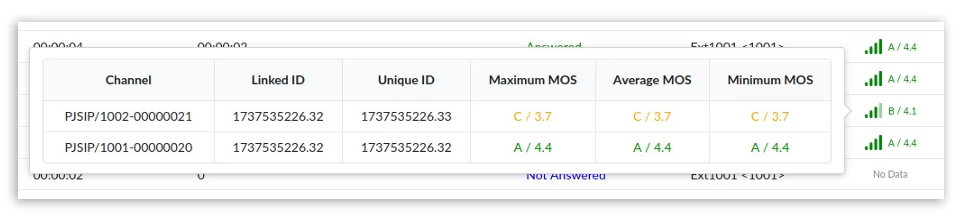
What Is A MOS Score?
A MOS score turns complex network performance information into a simpler quality rating. Instead of asking employees to interpret network data, the score provides an easy way to see whether calls are performing well or
whether audio quality may be deteriorating.
These ranges are useful as a guide, not a diagnosis on their own. A single low score may reflect a temporary problem, while repeated or sustained low scores are a stronger sign that something in the network or call environment needs attention.
Why Monitoring Call Quality Matters
Without call quality metrics, many businesses only learn about voice problems after someone complains. By then, the issue may have already affected customer conversations, sales calls, support interactions, or internal collaboration.
Call Quality Metrics gives users visibility into the performance of their calls so they can identify:
Ongoing quality trends across calls.
Sudden drops that may point to a temporary network issue.
Sustained low MOS scores that deserve investigation.
Patterns tied to a specific location, device, network connection, or time of day.
This helps businesses move from reacting to complaints to identifying potential problems sooner.
What Can Cause A Low MOS Score?
A lower MOS score does not automatically mean there is a problem with the phone system itself. Voice quality depends on the entire path of the call, including the internet connection and local network conditions.
Three common network factors affect MOS:
Latency
Latency is the delay between when one person speaks and when the other person hears them. High latency can cause awkward pauses, interruptions, or people talking over one another.
Jitter
Jitter is variation in the timing of voice-data packets arriving over the network. Too much jitter can make calls sound choppy, distorted, or uneven.
Packet Loss
Packet loss happens when pieces of voice data do not reach their destination. Even relatively small amounts of packet loss can result in missing words, clipping, or poor audio quality.
How To Use Call Quality Metrics
The most valuable approach is to look for patterns rather than overreacting to one imperfect call.
For example, if a user sees one lower MOS score but all other calls are strong, the issue may have been temporary. It could be related to a short internet disruption, a weak Wi-Fi connection, or a problem affecting the other party on the call.
However, if you see repeated low scores for the same employee, office, or time period, that is a stronger signal to investigate. You may want to check the local network, internet connection, Wi-Fi environment, device setup, or whether other users are experiencing similar issues.
A Practical Example
Imagine a customer service representative reports that afternoon calls frequently sound choppy. With Call Quality Metrics, the team can review MOS scores and see whether the issue occurs repeatedly at that time.
If the scores drop consistently every afternoon, the problem may be related to increased network use, an overloaded Wi-Fi environment, or another recurring condition. That gives your IT team or service provider a starting point for troubleshooting instead of relying on vague reports that “calls sounded bad.”
Better Visibility, Faster Resolution
Call quality affects more than technical performance. It affects the customer experience, employee productivity, and the professional image of your business.
With MOS-based Call Quality Metrics, users can monitor call performance, recognize warning signs, and provide more useful information when they need help. This makes it easier to investigate voice-quality issues and work toward a faster resolution.
Why Choose Fireline Communications?
- Same-day service replacement
- Crystal-clear call quality
- No equipment changes required
- We match your existing features
- Unbeatable pricing
We can replace your service in one day and keep your business connected without interruption.
Contact Fireline Communications today to upgrade your lines. You can also call us now! 1-877-347-3147
We’re local, responsive, and ready to earn your trust. Stop waiting. Start communicating.
FAQ
What are Call Quality Metrics?
Call Quality Metrics are measurements that show how well a voice call performed. They help users identify call-quality trends, sudden drops, and recurring problems that may point to network performance issues.
What is a MOS score?
MOS stands for Mean Opinion Score. It is a voice-quality rating that generally ranges from 1 to 5, with higher scores indicating a better call experience.
What is considered a good MOS score?
A MOS score above 4 is generally considered high-quality voice service. Scores between 3.6 and 4.03 may still be usable but can include noticeable audio issues, while lower scores can indicate a more serious quality problem.
Does one low MOS score mean my phone system is failing?
Not necessarily. One low score can be caused by a temporary condition, such as a brief internet interruption, weak Wi-Fi, or an issue on the other end of the call. Repeated or sustained low scores are more likely to indicate a problem worth investigating.
What can cause poor call quality?
Common causes include high latency, jitter, packet loss, weak Wi-Fi, internet congestion, or problems in the local network environment.
How can Call Quality Metrics help my business?
They give users a clearer way to identify and report voice problems. By reviewing trends and recurring low scores, teams can investigate issues earlier and reduce the impact on employees and customers.
Can Call Quality Metrics show whether a problem is temporary or recurring?
Yes. Monitoring scores over multiple calls helps users distinguish an isolated low-quality call from an ongoing pattern that may need troubleshooting.
Who should monitor call quality?
Any employee who relies on calls can benefit, but the feature is especially useful for customer service teams, sales teams, remote workers, supervisors, and IT administrators.
Last Updated on August 12, 2026